AFCI and GFCI Breakers Explained for Homeowners
AFCI breakers stop electrical fires; GFCI breakers stop shocks. Here's how they differ, where Upland code requires them, and what installation costs in 2026.
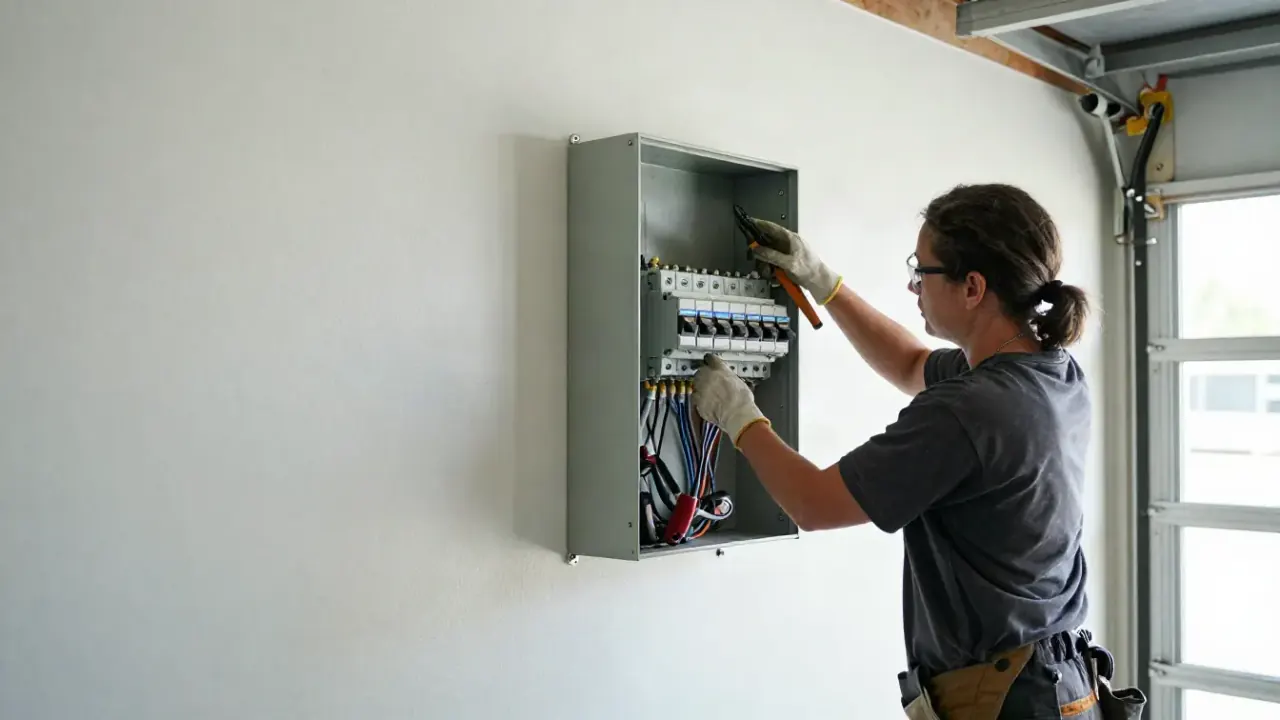
An AFCI breaker trips when it detects a dangerous arc in your wiring, while a GFCI breaker trips when current leaks to ground through water or a person. Both are life-safety devices, both mount in your electrical panel, and both are required by current California code in specific rooms of your Upland home. This guide breaks down the difference, where each one belongs, what installation costs in 2026, and the mistakes we see most often when homeowners try to sort it out alone.
AFCI vs GFCI Breakers: The Core Difference
AFCI and GFCI breakers explained in one line: AFCI protects your wiring from arc faults that start fires, and GFCI protects people from electric shock. They solve two different problems, and modern homes need both.
An arc fault is what happens when electricity jumps across a gap - a nicked wire behind drywall, a loose terminal, a cord crushed under a door. That tiny spark reaches 1,000°F or more and can smolder inside a wall for hours before flames show. A ground fault is current taking a shortcut to earth through water or a body instead of returning through the neutral wire. That is the shock you feel when a hair dryer hits a wet countertop.
Here is the practical split we explain to every homeowner:
- AFCI - watches the circuit for the electrical signature of arcing. Required in living areas: bedrooms, living rooms, hallways, closets, dining rooms.
- GFCI - watches for a 5 milliamp imbalance between hot and neutral. Required in wet areas: kitchens, bathrooms, garages, laundry, outdoors, crawl spaces.
- DFCI (dual-function) - one breaker that does both jobs. Common in new panels where a single circuit feeds a bedroom with an ensuite bath.
If you are upgrading an older panel in Upland, this is the moment to get the breaker mix right. Our Electrical Panel Upgrade Upland CA service covers the full swap - panel, breakers, labeling, and permit - so you are not retrofitting safety devices one at a time later.
What Is an AFCI Breaker and What Does It Do?
An AFCI breaker is a circuit breaker that continuously monitors the electrical waveform on a branch circuit and trips when it detects the high-frequency signature of an arc. It looks like a standard breaker with one extra wire - a white pigtail that lands on the neutral bar - and a test button on the face.
Arcing is sneaky. A staple driven too tight through Romex, a receptacle that has been backstabbed and loosened over 20 years, or a lamp cord pinched under a carpet all create micro-arcs that generate heat without tripping a standard breaker. Standard breakers only care about overloads and short circuits. They will happily sit there while a wall stud chars.
We install AFCI protection on every bedroom, living room, dining room, hallway, and closet circuit in Upland homes. The 2022 California Electrical Code (based on the 2020 NEC, Section 210.12) requires AFCI protection on essentially all 120-volt, 15- and 20-amp branch circuits in dwelling units. If your panel was installed before the mid-2000s, you almost certainly have none.
One thing homeowners notice: AFCIs trip more often than old breakers. That is the point. A vacuum with a worn cord, a cheap extension cord, or a failing ceiling fan will trip an AFCI where a standard breaker would not. If yours trips repeatedly, the breaker is doing its job - something on that circuit needs attention. Our AFCI breaker installation near me Upland service includes a circuit-by-circuit check so we can tell you whether the fault is the wiring or the appliance.
What Is a GFCI Breaker and Where Does It Belong?
A GFCI breaker is a breaker that compares the current leaving on the hot wire to the current returning on the neutral and trips within 25 milliseconds if the difference exceeds 5 milliamps. That threshold is set to protect a human heart, not just equipment.
Five milliamps is roughly the current a 60-watt bulb draws at one-quarter brightness. It is small enough that you might not feel it, and large enough that sustained exposure can stop a heart. GFCI devices cut power before that happens.
Where GFCI protection is required in a Upland home:
- Kitchen countertop receptacles (within 6 feet of a sink)
- All bathroom receptacles
- Garage receptacles, including the one your freezer is plugged into
- Laundry areas and utility sinks
- Outdoor receptacles, including patio and pool equipment circuits
- Crawl spaces and unfinished basements
- Any receptacle within 6 feet of a wet bar sink
You can get GFCI protection two ways: a GFCI receptacle at the point of use (the outlet with the test/reset buttons), or a GFCI breaker at the panel that protects the entire circuit. Breakers make more sense when one circuit feeds multiple outlets in a wet area, or when the outlets are behind appliances and hard to reach. Our GFCI breaker installation Upland CA work covers both approaches, and we will tell you which one fits your panel and your budget.
Do I Need AFCI and GFCI Breakers in Upland, California?
Yes - if your home was built before the mid-2000s, or if you have added circuits without pulling a permit, you likely need both. Current California code requires AFCI protection on most living-area circuits and GFCI protection in every wet or damp location.
Upland has a housing mix that makes this question come up constantly. The older blocks near Electrical Panel Upgrade in Historic Downtown Upland include homes from the 1920s through the 1950s with 60-amp fuse boxes and two-wire cloth wiring. Those homes have zero AFCI or GFCI protection, and many still have ungrounded circuits. The newer tracts in Electrical Panel Upgrade in The Colonies were built in the 1980s and 1990s - they have grounding and a modern panel, but the breakers predate AFCI requirements entirely.
Here is the practical rule we give homeowners: if you are touching the panel for any reason - adding a circuit, upgrading service, replacing a failed breaker - bring the safety devices up to current code at the same time. The labor is already on site. Doing it later means paying for a second visit.
Two situations force the issue regardless of what you want:
- You are selling the home. A home inspector will flag missing AFCI/GFCI protection, and buyers in the current market ask for it to be corrected.
- You are adding a circuit. Any new branch circuit in a dwelling must meet current code, which means AFCI and, where applicable, GFCI.
How Much Does AFCI and GFCI Installation Cost in Upland CA?
Typical 2026 pricing in this area runs $180 to $320 per AFCI or GFCI breaker installed, including the breaker, labor, and labeling. A whole-panel conversion that adds AFCI and GFCI protection across 12 to 20 circuits usually lands between $1,800 and $3,600.
What moves the number:
- Breaker brand and panel age. A current Square D or Eaton panel takes breakers off the shelf. A discontinued panel - Zinsco, Federal Pacific, or an older Murray - may need a panel replacement before we can install modern safety breakers at all.
- Circuit count. Each AFCI or GFCI breaker protects one circuit. A 20-circuit panel costs roughly twice a 10-circuit panel in parts.
- Dual-function breakers. A DFCI breaker costs $60 to $90 in parts versus $40 to $60 for a single-function unit, but it replaces two devices on one circuit.
- Permit and inspection. The City of Upland requires a permit for panel work and breaker additions. Permit fees run $150 to $400 depending on scope.
We give a flat, written price before we start - no hourly surprises, no "while we're in there" add-ons. If the panel itself is the problem, our outdated panel replacement Upland CA service handles the full swap, and the AFCI/GFCI breakers go in as part of the same job.
Can AFCI and GFCI Breakers Prevent Electrical Fires in Upland CA?
Yes. AFCI breakers cut power before an arc can ignite surrounding material, and GFCI breakers prevent the ground faults that start many electrical fires in the first place. Together they address the two leading electrical ignition sources in homes.
The numbers back this up. The U.S. Consumer Product Safety Commission estimates that AFCI devices can prevent roughly 50 percent of the electrical fires that occur annually in the United States. The National Fire Protection Association reports that electrical failures or malfunctions cause roughly 45,000 to 50,000 home fires each year, with arcing faults responsible for a large share of them.
GFCI protection has a similar track record. Since GFCI requirements were added to the code in the 1970s, electrocutions from consumer products in and around the home have dropped by more than 80 percent. That is not a marketing claim - it is a public health outcome measured over five decades.
In Upland specifically, the risk factors are real. Summer temperatures push air conditioners and pool pumps to their limits. Winter brings space heaters on extension cords. Both create exactly the conditions AFCIs and GFCIs are built to catch. If your panel is in Electrical Panel Upgrade in North Upland or any other neighborhood with 1970s-era wiring, this is the single highest-value safety upgrade you can make.
Common Mistakes We See With Safety Breakers
The most common mistake is installing a GFCI receptacle on an ungrounded circuit and calling it done. A GFCI will still protect people without a ground wire, but it does not provide AFCI protection, and it does not make the circuit code-compliant for modern use.
Other mistakes we correct regularly:
- Putting AFCI on a circuit that shares a neutral with another circuit. Shared neutrals cause nuisance tripping. The fix is to separate the neutrals or use a two-pole AFCI.
- Using a GFCI breaker on a refrigerator or freezer circuit. A nuisance trip while you are on vacation means spoiled food. We put those on a dedicated non-GFCI circuit unless code requires otherwise.
- Ignoring the panel brand. Some older panels cannot accept modern AFCI breakers at all. Installing a breaker that does not seat properly is a fire hazard, not a safety upgrade.
- Skipping the permit. Unpermitted electrical work shows up in a home inspection and can stall a sale. It also voids some homeowner insurance claims after a fire.
- Not labeling the panel. A correctly labeled panel tells the next electrician - or the next homeowner - exactly which circuit is protected by what. We label every breaker we install.
If you have already had breakers installed and they trip constantly, the problem is almost always one of the first three items on that list. Our electrical load calculation and inspection Upland CA service traces the fault and tells you exactly what needs to change.
When to Call a Professional
Call a licensed electrician when the work involves opening the panel, adding a circuit, or replacing a breaker. Panel interiors hold 240 volts and full available fault current - there is no safe DIY version of this job.
Specific situations where we want to hear from you:
- Your breakers trip repeatedly and resetting them does not hold.
- You see scorch marks, smell burning plastic, or hear buzzing at the panel.
- Your panel is a Zinsco, Federal Pacific, or Pushmatic brand.
- You are adding a circuit for an EV charger, hot tub, or ADU.
- You are buying or selling a home in Upland and the inspection flagged the panel.
Upland Electrical Panel Upgrade handles AFCI and GFCI breaker installation, panel replacement, and full service upgrades across Upland and the surrounding foothill communities. We pull the permit, do the work, and walk you through what changed before we leave.
Frequently Asked Questions
What is the difference between AFCI and GFCI breakers in Upland CA?
AFCI breakers trip on arc faults - the sparking that starts electrical fires - and protect wiring in living areas. GFCI breakers trip on ground faults, the current leaks that cause shocks, and protect people in wet areas like kitchens, baths, and garages. Both mount in your panel and both are required by current California code.
Do I need AFCI and GFCI breakers in Upland, California?
Yes, if your home was built before the mid-2000s or you have added circuits without a permit. Current code requires AFCI protection on most living-area circuits and GFCI protection in every wet or damp location. Homes in older Upland neighborhoods like Historic Downtown often have neither.
How much does AFCI and GFCI installation cost in Upland CA?
Expect $180 to $320 per breaker installed in 2026, including parts and labor. A full panel conversion with 12 to 20 circuits runs $1,800 to $3,600. Permit fees add $150 to $400 depending on scope. We quote a flat price before starting.
Can AFCI and GFCI breakers prevent electrical fires in Upland CA?
Yes. The CPSC estimates AFCI devices can prevent about 50 percent of home electrical fires, and GFCI protection has cut electrocutions from consumer products by more than 80 percent since the 1970s. Together they address the two leading causes of electrical fires and shocks.
Why does my AFCI breaker keep tripping?
An AFCI breaker trips when it detects arcing on the circuit. Common causes include a worn appliance cord, a loose receptacle connection, a shared neutral with another circuit, or a failing ceiling fan. The breaker is doing its job - the circuit needs inspection, not a bigger breaker.
Get Help With Electrical Panel Upgrade in Upland
If your panel is still running on 1970s-era breakers, or you need AFCI and GFCI protection added to meet current code, we can handle the whole job - permit, installation, labeling, and inspection. Call Upland Electrical Panel Upgrade at (909) 850-3163 and we will give you a flat price over the phone.