What Is an Electrical Load Calculation?
A load calculation totals every appliance and circuit in your home to prove whether your electrical panel can safely carry the demand. Here's how Upland homeowners use one.
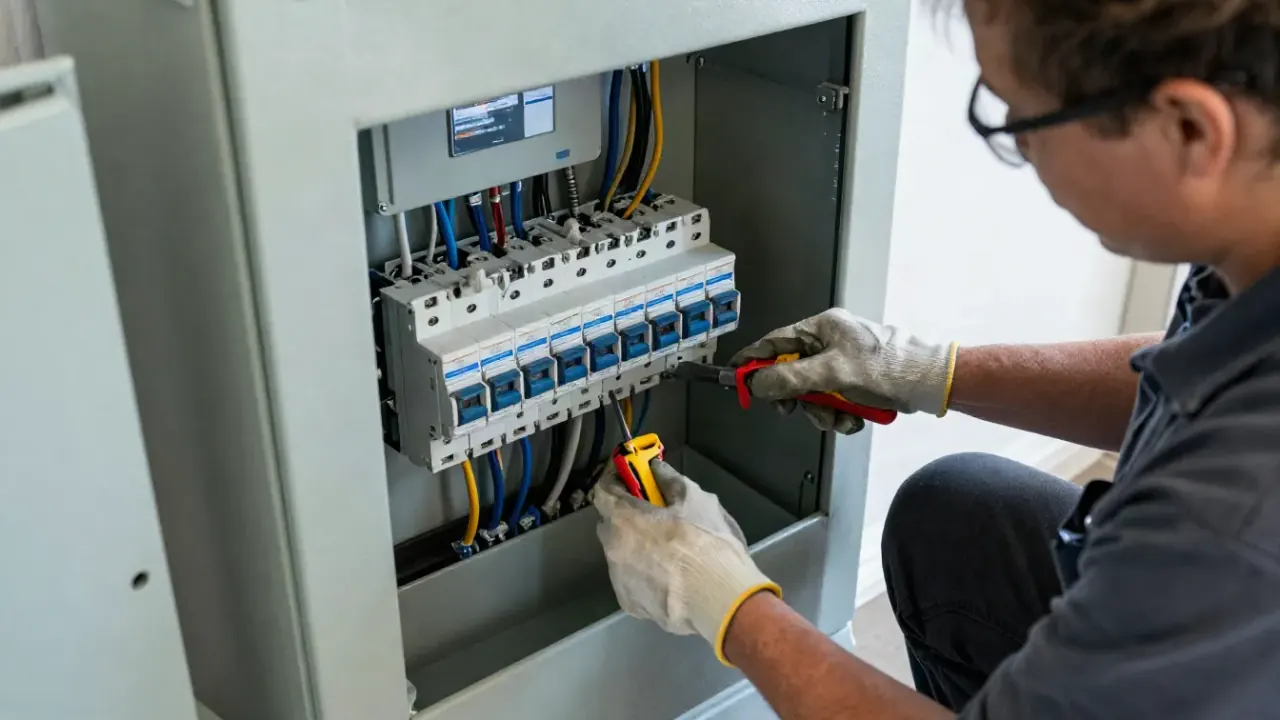
An electrical load calculation is a math-based assessment that adds up the wattage of every light, outlet, and appliance in your home to determine whether your electrical panel can safely carry the total demand. In Upland, California, that number decides whether you can add an EV charger, a solar system, or a new air conditioner without overloading your service.
We run these calculations every week for homeowners across Upland, and the results often surprise people. Below, we walk through how the math works, what triggers the need for one, what it costs in 2026, and when the answer is a breaker panel replacement Upland CA rather than a smaller fix.
What Is an Electrical Load Calculation?
An electrical load calculation is a standardized accounting method that totals the expected electrical demand of a home and compares it to the capacity of the service panel feeding it. Electricians use it to prove, in numbers, that a panel can handle the load placed on it - or to show exactly how much it falls short.
The calculation follows a formula laid out in the National Electrical Code, Article 220, which sets the rules for how much demand each type of load contributes. A 1,500-square-foot Upland home with a 100-amp panel might pass the math with a gas range and gas water heater, but fail the moment you add a 48-amp EV charger and a 4-ton air conditioner.
Every calculation starts with two numbers: the square footage of the home and the amperage of the existing panel. From there, we add up fixed appliances - range, dryer, water heater, dishwasher, disposal, HVAC - then apply demand factors that account for the fact that not everything runs at once.
Why Do You Need a Load Calculation in Upland, California?
You need a load calculation in Upland, California because the city's building department requires one before it will approve a panel upgrade, service change, or major new circuit. Without it, the permit gets rejected and the work stops.
There are three practical reasons homeowners here end up needing one:
- Permits and inspections. Upland follows the California Electrical Code, and any service upgrade from 100 amps to 200 amps requires a load calc submitted with the permit application.
- New high-draw appliances. EV chargers, tankless water heaters, heat pumps, and mini-split systems all push a home past what a 100-amp panel can carry.
- Insurance and disclosure. Some carriers now ask for proof of adequate service when a home has a 60-amp or fuse-box service, especially in older neighborhoods.
We also see it come up during real estate transactions. A buyer's inspector flags a 60-amp service, and the sale stalls until someone produces a load calculation showing what the home actually needs.
How to Calculate Electrical Load in Upland CA
To calculate electrical load in Upland CA, you total the general lighting load, add fixed appliances at their nameplate ratings, apply the code's demand factors, and compare the result to the panel's amperage at 240 volts.
Here is the process we use on every job:
- General lighting and receptacles. Multiply square footage by 3 volt-amps per square foot. A 2,000-square-foot home gets 6,000 VA.
- Small appliance and laundry circuits. Add 1,500 VA for each of the two required kitchen circuits and 1,500 VA for laundry.
- Fixed appliances. Add the nameplate rating of the range, dryer, water heater, dishwasher, disposal, and HVAC. A 4-ton AC pulls roughly 5,000 VA on its own.
- Apply demand factors. The first 10,000 VA counts at 100 percent; anything above that counts at 40 percent for most residential loads.
- Add the largest motor at 25 percent. This accounts for the inrush current when a compressor or pump starts.
- Divide by 240 volts. The result is your service load in amps. Compare it to the panel rating.
A typical 1,800-square-foot Upland home with gas appliances lands around 90 to 110 amps of calculated load. That fits a 100-amp panel - barely. Add an EV charger at 40 amps continuous and you are over the limit, which is why so many homeowners here end up needing an electrical service upgrade Upland CA.
If you want the exact number for your house, we run a full electrical load analysis Upland, California that includes panel inspection, breaker mapping, and a written result you can hand to the city.
Load Calculation for Panel Upgrade in Upland, California
A load calculation for panel upgrade in Upland, California is the document that tells you whether you need 200 amps, 400 amps, or a smaller correction like a subpanel. It is the first step in the project, not an afterthought.
Here is how the numbers usually shake out for homes we work on:
- 100-amp panel, gas appliances, no EV. Calculated load lands near 80 to 100 amps. You can usually stay put.
- 100-amp panel with EV charger or heat pump. Load pushes past 120 amps. Upgrade to 200 amps.
- 200-amp panel with EV, solar, and pool equipment. Load can exceed 180 amps. A 200 to 400 amp service upgrade Upland CA gives you headroom.
- Fuse box or 60-amp service. Almost always fails the calculation. A fuse box to breaker panel conversion Upland CA is the fix.
We see a lot of this in the older housing stock around Electrical Panel Upgrade in Historic Downtown Upland, where 1920s and 1940s homes still run on 60-amp services and knob-and-tube wiring. Those panels were sized for a refrigerator, a radio, and a few lights. They were never designed for a modern kitchen.
Electrical Load Calculation for EV Charger in Upland CA
An electrical load calculation for EV charger in Upland CA almost always determines whether you can add a Level 2 charger without a panel upgrade. A 48-amp hardwired charger draws 11,520 watts continuous - more than most 100-amp panels have left over.
There are three ways the math can go:
- You have room. Calculated load plus 48 amps stays under 80 percent of the panel rating. We pull the permit and install the circuit.
- You have partial room. A load management device or a lower-amperage charger (32 or 40 amps) gets you under the limit without a panel change.
- You have no room. The panel is already near capacity. The answer is a EV ready panel upgrade Upland CA to 200 amps.
Most Upland homes built before 1990 fall into the third category. The good news is that a 200-amp upgrade future-proofs the house for a second EV, a heat pump, or a battery system down the road.
Load Calculation for Solar Panels in Upland CA
A load calculation for solar panels in Upland CA works a little differently, because solar adds supply rather than demand. The calculation still matters, though, because the panel busbar has to handle both the utility feed and the solar backfeed.
The rule most electricians apply is the 120 percent busbar rule: the sum of the main breaker and the solar breaker cannot exceed 120 percent of the busbar rating. On a 200-amp panel with a 200-amp busbar, that caps your solar backfeed at 40 amps - about 9.6 kW of inverter output.
If you want a larger solar system, you have two options: a line-side tap, or a panel upgrade to a 225-amp or 400-amp busbar. We size this during the load calculation so the solar installer is not stuck redesigning the system later.
Battery storage adds another wrinkle. A Powerwall or similar unit backfeeds the panel the same way solar does, and the calculation has to account for both at once.
What to Watch Out For
The most common mistake we see is homeowners adding a big load - EV charger, tankless water heater, hot tub - without running the numbers first. The panel holds for a few months, then the main breaker starts tripping on hot afternoons.
Other things to watch for:
- Nameplate versus actual draw. A water heater rated at 4,500 watts pulls 4,500 watts. Do not use averages when the label is right there.
- Continuous versus non-continuous loads. EV chargers and pool pumps run for three hours or more, so they count at 125 percent of their rating.
- Federal Pacific and Zinsco panels. These panels appear in a lot of Upland homes built between 1950 and 1980. They fail the calculation and, more importantly, they have a documented history of not tripping on overload. We replace them rather than work around them.
- Aluminum branch wiring. Common in homes built between 1965 and 1973. It affects how we can add circuits and often forces a partial rewire.
- DIY load calculations. Online calculators miss the demand factors and the 25 percent motor adder. The city will reject them.
If your panel is a outdated panel replacement Upland CA candidate, the load calculation is what proves it to the inspector. We document every circuit so there is no argument at inspection time.
When to Call a Professional
Call a professional when your calculated load lands within 10 percent of your panel rating, when your panel is a brand known for failure, or when you are adding any load over 30 amps. Those are the situations where guessing gets expensive.
We handle the whole process: we inspect the panel, map every circuit, run the calculation, pull the Upland permit, and do the work. If the answer is a subpanel instead of a full upgrade, we will tell you - a subpanel installation Upland CA is sometimes the right call for a detached garage, ADU, or workshop.
We also install AFCI and GFCI breaker installation Upland CA as part of most panel upgrades, since current code requires arc-fault protection on most 120-volt circuits in a home.
Frequently Asked Questions
What is an electrical load calculation in Upland CA?
It is a code-based math worksheet that totals every load in your home and compares the result to your panel's amperage. Upland's building department requires one for any service upgrade, panel change, or major new circuit permit.
Why is a load calculation important in Upland, California?
It is the only accepted way to prove your panel can safely carry its load, and it is required for permits. Without it, you cannot legally add an EV charger, solar, or a large appliance circuit to most Upland homes.
How much does a load calculation cost in Upland CA?
Standalone load calculations in Upland run $250 to $500 in 2026, including the panel inspection and written report. When we do the calculation as part of a panel upgrade, we fold the cost into the project price.
Can a load calculation tell me if I need a panel upgrade in Upland CA?
Yes. If your calculated load exceeds 80 percent of your panel rating, or you are adding a large continuous load, the calculation will show it. That is the trigger for upgrading to 200 amps or more.
How long does a load calculation take?
The on-site inspection takes 45 to 90 minutes. The written calculation and report are usually ready within one to two business days, which is fast enough to keep most Upland permit timelines on track.
Get Help with Electrical Panel Upgrade in Upland
If your panel is tripping, your service is 100 amps or less, or you are planning an EV charger or solar, we can run the numbers and tell you exactly what your home needs. We handle the calculation, the permit, and the installation from start to finish.
Call Upland Electrical Panel Upgrade at (909) 850-3163 to schedule your load calculation and inspection.